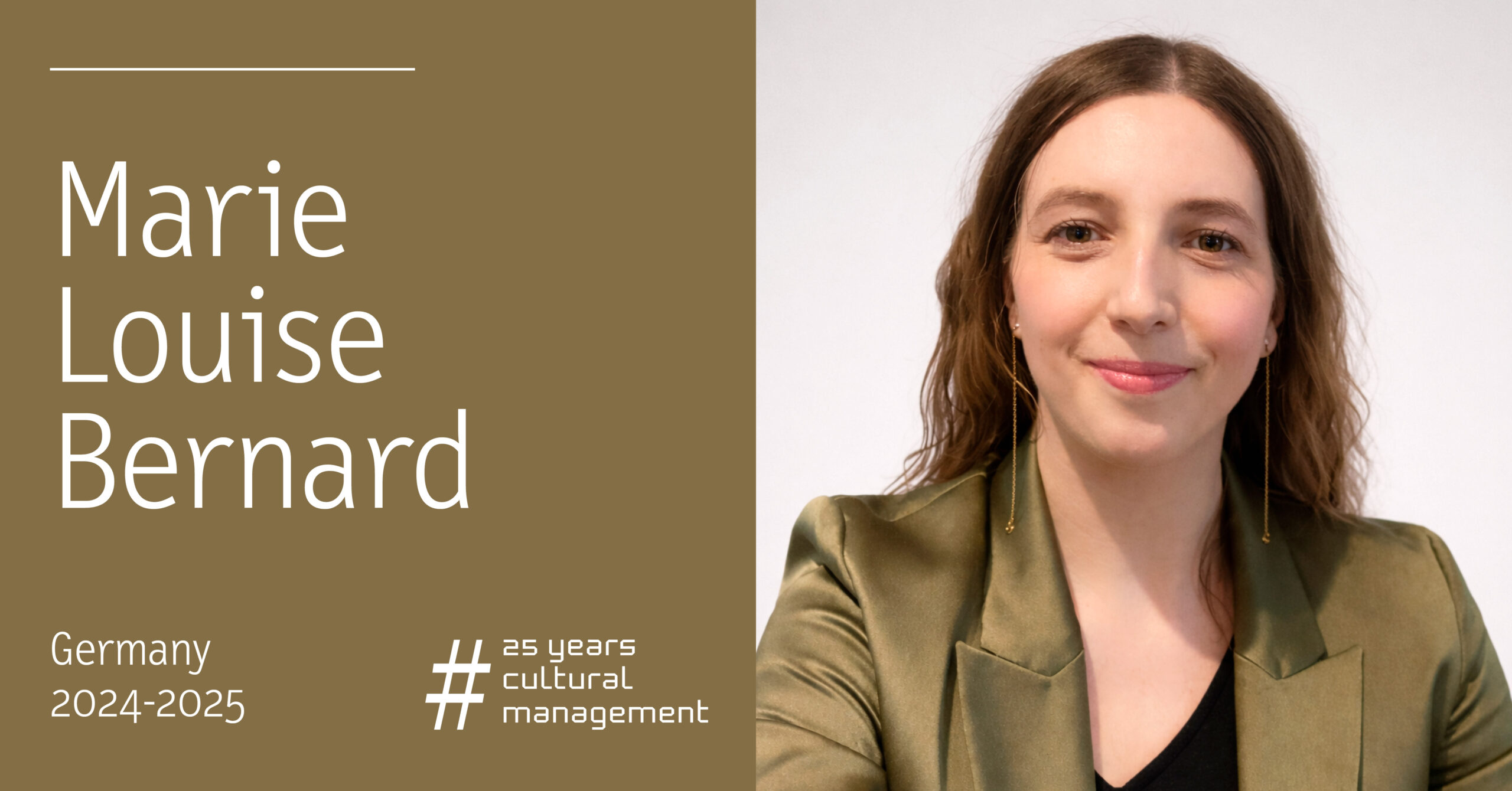
Marie Bernard is a cultural manager from Germany who completed a Master’s degree in Arts and Cultural Management at UIC Barcelona. After graduating in 2025, she reflects on her professional journey, her aspirations, and her experiences working with festivals and cultural institutions. She currently works as a Project Lead at the Bregenzer Festspiele in Austria.
Marie, what path led you to enroll in the UIC Master’s program?
I grew up surrounded by the arts and loved the magic of it all, the people, the energy, and I knew I wanted to be part of that environment somehow. Before the master’s, I completed an undergraduate degree in art, music, and media and spent a few years working for different festivals and media institutions.
Those years gave me valuable experience and a strong practical foundation, but over time I realized I wanted to take on more responsibility, advance my career, and grow both professionally and personally. I also felt I was missing a stronger theoretical base.
In this sector, you learn a lot by doing, moving from project to project and solving problems as they come up, which is great, but I wanted a deeper understanding of decision-making processes and how different parts of the field work together.
That’s where Barcelona came in. The program offered a great mix of academic and practical experience, allowing me to explore different areas of cultural management and figure out what I wanted to focus on next through a variety of assignments, study visits, and mentoring.
What stood out most to me about UIC was the teaching staff and their approach to the sector. They weren’t just teaching theory; they were practitioners who truly understood the realities of the field, which made all the difference, because at the end of the day, people make this profession.
I’ve loved the arts since I was a kid, but the master’s program really helped me expand my horizons and broaden my perspective, showing me what’s possible in the cultural sector and where my journey could lead.
What was your professional path after graduation? How did you end up at the Bregenzer Festspiele (Bregenzer Festival)?
After finishing the master’s, I was full of energy and ready to take on the world. I had the degree, a good amount of experience, and was ready for a role that would truly challenge me. So, I applied all over. Interestingly, the Hong Kong study trip really shifted my mindset. I had never been to Asia before, and suddenly I realized: technically, I could go anywhere.
During that phase, I completed a two-month remote internship with an American agency, International Classical Music Management (ICM), working in artist management. It was a mandatory part of the program, but doing it after graduation and in a different environment gave me a real sense of purpose during that “what now?” period.
At the same time, I had also applied to the Bregenzer Festspiele in Austria, without really expecting much, since it’s a major institution in the opera and theatre world, located right by Lake Constance at the border of Austria, Switzerland, and Germany. But to my own surprise, they reached out, invited me for an interview and in no time, offered me the job over the phone. It all happened incredibly fast, it was a real whirlwind.
As you just mentioned the extension week, let’s jump on the subject: In July 2025, you participated in the “ Study Extension Week” in Hong Kong, organised by the master’s degree in collaboration with The Chinese University of Hong Kong. This activity combined masterclasses, visits to cultural institutions, and meetings with industry professionals, providing students with a cultural immersion in Asia. How was your experience? Why do you think it is important for future culture managers to have international?
Hong Kong was truly an “out-of-body” experience. Thanks to the collaboration with The Chinese University of Hong Kong and the packed itinerary, it felt much less like a tourist trip and much more like a genuine insight into local life and the city’s arts ecosystem. Being able to visit institutions, attend masterclasses, and speak directly with professionals was a rare opportunity and not something you often experience as a student.
What struck me most was the generational difference. We met young entrepreneurs in their 20s and 30s running massive projects. In Europe, leadership roles are often held by older generations, so seeing their vision, level of determination and “can do spirit” was really inspiring.
I’m very grateful I got to take part in this trip and learn more about the cultural institutions and the city itself. Europe is a big part of the world, but it isn’t everything. Seeing how other cultures approach management and creativity adds so much to your toolkit and perspective, professionally and personally. It’s a great opportunity and I’d honestly tell anyone: if you have the chance, do it.
As a Project Lead in Artistic Administration, you work at a complex intersection. How would you describe your daily life there?
I work in Artistic Administration, which is basically the engine room of the festival. I’m not tied to just one production; I have a bird’s-eye view of everything. It’s a very collaborative, all-hands-on-deck kind of role, while also having responsibility and being involved in logistical decision-making.
My tasks are quite diverse. I’m in charge of the music scores, acting as the link between the productions and the publishing houses. I order all the necessary materials, prepare the physical and digital scores for singers and musicians, draft contracts, and coordinate the rental of any special instruments.
I also manage the in-house booking software, which makes me the person people turn to when they need rehearsal spaces or want to book a space for a production. I work closely with different departments and help create the weekly and daily rehearsal and performance schedules during the festival season. It’s a challenging role, but everyone is very supportive, it never gets boring, and I’m learning a lot while getting to be part of a truly creative, dynamic environment.
What aspects of the music and festival industry do you think are most underestimated?
Probably the sheer amount of hustle behind the curtain. People see the final production, but not the specific skill sets required to make something like that happen on such a large scale. You need people who are quick on their feet, who can think across departments, and who stay calm under pressure.
It’s not just about being a “manager”. It’s about having a background that allows you to adapt quickly, knowing when to push forward and when to step back. It’s a learning curve, but that’s also what makes the field so exciting. Everyone plays a role, and the team has to function as a system.
You’ve mentioned that hierarchy in the cultural field can be tricky. What communication practices work best for you?
For sure, work environments in the cultural sector can be challenging, and approaches to hierarchy differ a lot from country to country. What works in Spain doesn’t necessarily work in Austria. Fortunately, my current employer does a great job with onboarding and team building, which makes adapting much easier, especially since we’re such an international team, with people from very different backgrounds.
That said, I’ve faced difficult leadership situations in the past, and one of my biggest lessons has been to protect your mental well-being and knowing your worth, even at the beginning of your career. It teaches you to stand up for yourself, because in the end, you’re there to learn and contribute.
Adapting to an established team obviously takes time, but the people in charge also have a responsibility to make new colleagues feel welcome. I’ve learned over time that asking for help and working through things together is much better than struggling alone. Because let’s face it, if the people behind the scenes burn out, the whole institution suffers.
What advice would you give to students or alumni looking to move from “supporting” to “leading” projects?
- Get your foot in the door early: I worked every summer and spring break during my undergrad and had a part-time job during the master’s. Even if it’s just for a few weeks, it’s worth putting on your CV
- How you present your experience matters: In interviews, it’s not about how long a job lasted, but how you talk about what you learned and what motivated you.
- Go after what you want: There is no shame in dreaming big and saying it out loud.
- Don’t be afraid to take a leap: If an opportunity feels right and could benefit you in the long-term, take it. You can always change direction later, but you’ll gain experience
- Listen to your gut: I never thought I’d enjoy the academic side of things, but the master’s inspired me to explore research and fellowships. I was recently accepted to lead a mentoring session at an international classical music conference on hierarchy in the performing arts, something I couldn’t have even imagined a few years ago.