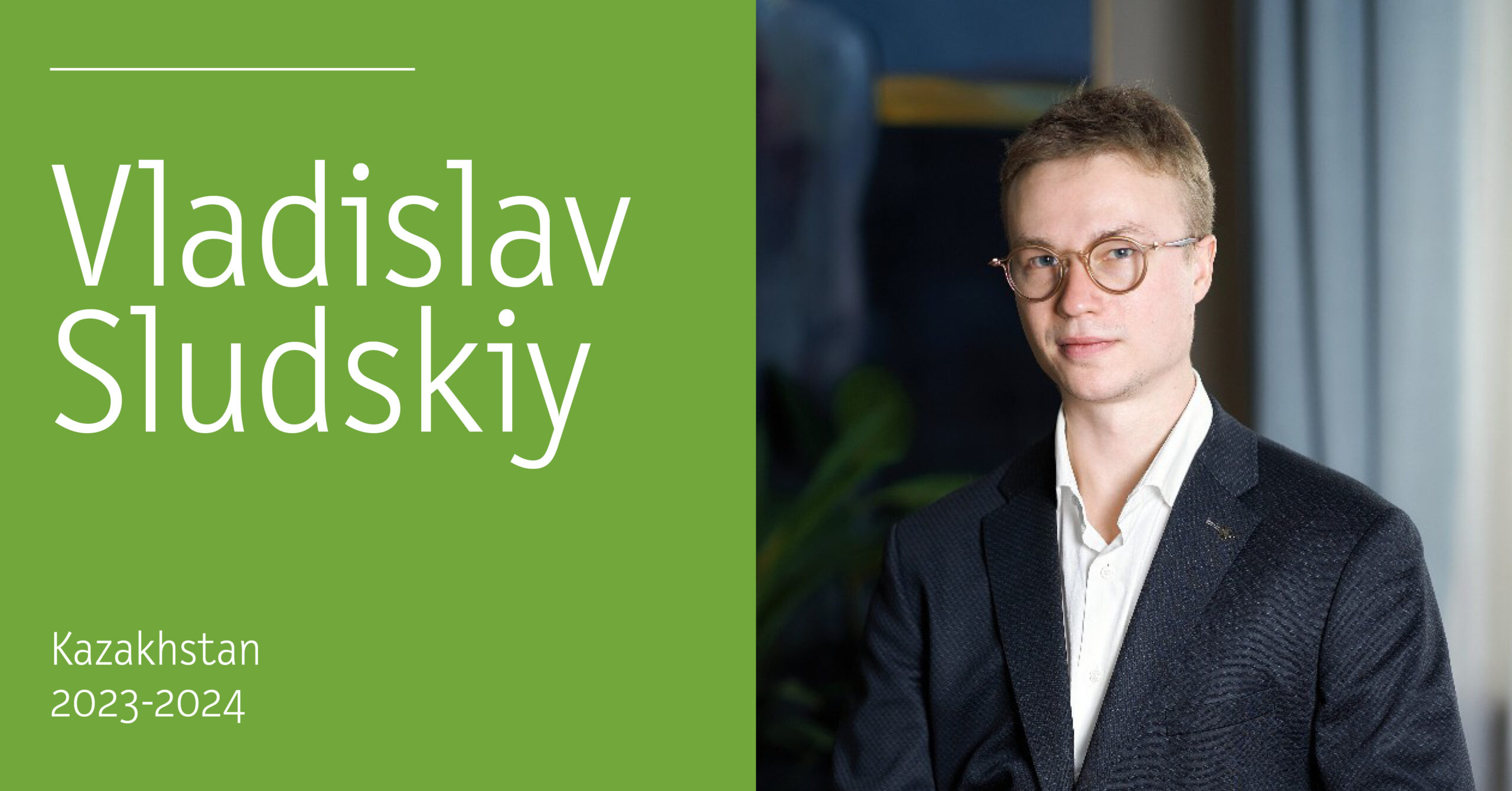
Vladislav Sludskiy is an experienced cultural manager who came from Almaty, Kazakhstan, last year to pursue the Master’s Degree in Arts and Cultural Management at UIC Barcelona. In this interview, Vlad shares insights from his career, discussing his experiences in New York and Kazakhstan, his perspective on the evolving role of galleries, and the challenges of fundraising for cultural initiatives. He also talks about his current projects, including Ancient Futures, an upcoming exhibition on bio-design and bio-architecture.
Vladislav, please tell us about yourself. What is your professional experience, where do you come from, and who have you worked for?
I’m from Kazakhstan, Almaty, which was the former capital and is arguably the largest city in Central Asia, as well as the financial and cultural capital. There, I started my professional path in cultural management back in 2010 by organizing an annual festival of public art in Almaty. ARTBAT, supported by the non-profit Eurasian Cultural Alliance, started as a public exhibition of sculptures installed across the city center. It grew over time and changed its format each year from 2010 to 2023, when it ceased its activities.
Meanwhile, in 2011, I enrolled in a bachelor’s program in New York, so I was studying cultural management, flying back to Almaty to run the festival, and working on some projects here and there. As part of my American experience, I also interned at the Gagosian Gallery. During that time, I got to meet Ethan Cohen, who became my first boss and gave me a valuable reference. I stayed at this mid-sized gallery with a relatively small team for about three and a half years, where I managed some exhibitions and gradually took on more responsibilities, eventually becoming a kind of director. Of course, there was a lot of empirical experience, many mistakes, stupid exhibitions, wrong budgets, wrong timelines…
But then, maybe after 10 years, you start feeling comfortable in the profession, and I believe it has to do with almost all of the creative industries… It’s a field where you often learn by doing.
You’ve mentioned on social media that you have a “New Yorker’s mind.” What does that mean?
A New Yorker’s mind means not focusing on the negative aspects of any problem. You only see opportunities, and you try to work in a fast-paced environment, dealing with the resources and timelines you have, while still remaining happy and creative. Cultural industries, in particular, are often last-minute, so you need to be flexible. And it’s project management, so things might go wrong, and you cannot plan everything. You must be adaptable, quick-witted, emotionally intelligent… just really aware of what’s happening around you.
What are the most challenging aspects of being an art gallery director?
Honestly, maybe I’m so in love with what I do that it didn’t seem particularly challenging. First of all, my experience in Kazakhstan, where there was a lack of infrastructure, almost gifted me with the ability to work with limited resources under pressure. So New York seemed manageable to me after Kazakhstan. It wasn’t difficult.
I think it’s about taking it easy and not stressing about things and deadlines. The creative industry is not rocket science. No one will die if your painting is a little off. Of course, it won’t look good on you, it’s unprofessional, but still, I think maybe there is a certain degree of incompleteness and chaos that we need to accept if we work as cultural managers: “the perfect is the enemy of the good.”
Some people may say that galleries seem to be into the luxury business and maybe that sets them far from the community. What are your thoughts about this and how can they manage to be closer to the people?
Well, I think art was never a candy for the masses and I do not think it’s for everyone. The elitist component of culture has always been there, so we can relax about that. However, I’m quite impressed with how mass culture works in Barcelona, in Spain, and in all Latin environments. I think that’s really unique and incredible.
That said, I think things are changing. Even in highly capitalist places like New York and London, mega-galleries have become institutions. Many of them have publishing houses and work for the general public. Some are now even more powerful than certain museums, and they do engage with the community. Of course, it’s often a somewhat privileged community, but they’re not entirely isolated.
You’ve also taken part in the Eurasian Cultural Alliance, so you can say you’ve been part of both worlds. Do you think cultural managers should be aware of the characteristics of each model, the business-oriented one and the non-profit one?
Yes, the ARTBAT festival was a nice bridge between city culture, citizens, and art, almost excluding the agency in the form of a museum or gallery. We immediately understood the necessity of having some kind of non-profit structure for this purpose because most founders want this particular form of organization, and it’s important to keep this in mind. But it’s hard, and it depends on how good you are in ethics and utilitarianism. So it’s a tricky balance, and if you can navigate it, go for it. Ideally, it should make your life much better in a sense, but it’s very debatable because I’m neither this social engineer who will sacrifice his career for good values.
Could you give some advice on fundraising when it comes to cultural non-profit organizations?
In ARTBAT, we received funding from partners like Chevron, the British Council, and the Goethe Institute, but also from companies like Indrive. So we’re talking about numbers like $20,000 to $40,000 per project. Most likely, I would say you do it step by step. We have this wrong idea in our minds that things can be planned, and again, I don’t believe in the myth of culture that you can sit down, write a grant, receive money, and work towards the grant. My experience shows that things are more chaotic, and you just go and jump on the train.
But it’s important to create an environment for these fundraising campaigns. You must start with small things, like giving a series of free lectures on the subject and taking proper documentation shots. It’s really many small steps instead of one grand big one. Then the right person will come your way. Very much by word of mouth: the guy you met at the party, the girl you talked to online somewhere, things like that.
Every company and institution has KPIs, and they all have their vision of how things are, so you always try to equip those people with the best tools you have as a producer to improve them. Also, 99% of the time in this profession, you will be working with middlemen, so your goal as a cultural producer is to wrap the information in the easiest way for your interlocutor so they will pass it along, and then the other person will pass it on, over and over again. Making proper presentations, having basic skills in layout, and being clear about your ideas is super important.
How was your experience last year in the master’s program?
I’m really happy about this experience. I wanted to move, and I think education is a very nice, smooth transition. Very good, I had a very good impression. It was more about having my foot in the door for Barcelona, and it turned out to be quite nice.
What I’d remark about the program is that we met some real, interesting people like Sara Puig, interesting professors. These kinds of practicing specialists are so valuable because people make this profession, and only people can really help you get places, and you learn only from people. It’s really about people, and communication skills.
Is the same theoretical know-how applicable to both industries, commercial and cultural?
Maybe the same rules apply if you’re running a shopping mall or a theater company. It doesn’t really matter. It’s books, it’s management, it’s a good, healthy attitude and those things. But also, I think that people always forget that we are really doing crafts here. And in a sense, you need a master, you need your teacher who will pass on this sacred knowledge to you as a cultural producer. You can only learn from other people. And people will help you because someone helped them at some point. And it’s very important to always learn.
And what are you working on now?
I’m preparing an exhibition called Ancient Futures for April within the program of the Eurasian Cultural Alliance. We are presenting different potential solutions for bio-design and bio-architecture with a group of specialists from different places like Ljubljana, Kazakhstan, or Uzbekistan. It’s actually going to be sponsored by the British Council. It’s a relatively new field… something different. It’s basically the idea that you can algorithmize nature and bring ecosystems to cities. A noble example of biological architecture would be Mary Oxman, who did the ‘Silk Pavilion’ for MoMA, creating an environment in which silkworms used its roof.
For example, we’re going to present a very sustainable project of bee houses made out of mycelium — this mushroom that grows in all three directions — which has already been proven and used in construction, to help bees by recreating these structures within cities. We’re also going to look at how to shade our cities to decrease the temperatures. We’re going to look at hard cheese as a construction material and crazy things like that — very experimental.
In the long term, ideally, I’d love to work with museums, maybe curate a Biennale one day or build private collections: have like 5-10 large, serious families who collect maybe $1-10 million a year; and then be able to live off commissions, reinvest from commercial activities to non-profit activities, and keep growing this new generation of Central Asian artists. But I also want to do a PhD because it would be nice to keep using those two tracks, academic and commercial. I think they are relatively equally important.