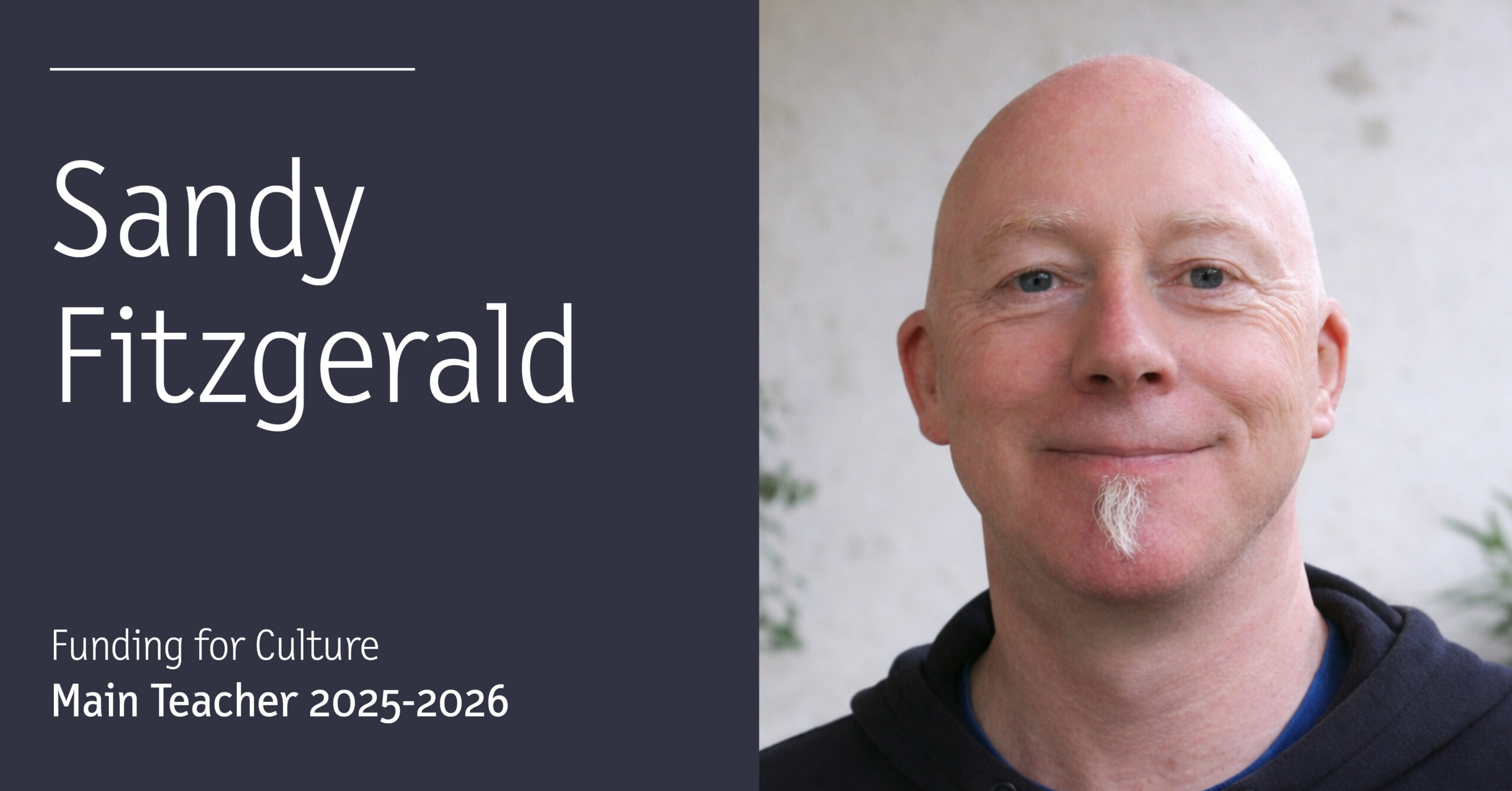
Sandy Fitzgerald is a freelance consultant and professor specializing in cultural funding. Since 2020, he has been a lecturer at the Universitat Internacional de Catalunya (UIC Barcelona), where he teaches Funding for Culture. He also co-directed the Olivearte Cultural Agency for 15 years (2008–2023).
Cultural funding in the arts is a key challenge for cultural managers today. In this interview, Sandy Fitzgerald reflects on the importance of purpose-driven leadership, the shift from creative passion to structured action, and the crucial role of cultural equality in fostering a healthy, balanced society.
How dis your early life shape your path into the cultural sector, and when dis you first realise its importance in your life?
I grew up in Dublin, Ireland, at a time when the country was very poor and isolated from the rest of the world and my family was working class. We lived in one of the first social housing estates in the country and life was, let’s say, challenging. My escape was through my imagination. I discovered I could create my own worlds that were safe, exciting and fun and, as a kid, I loved to draw or write stories or build things out of scrap materials. I didn’t know anything about art but it saved me, in a way.
Then I was fortunate because the 1960s happened and suddenly my generation were changing the world through their imagination and I threw myself into this : playing music, publishing poetry and performing small plays with my like-minded friends. After reading about what was happening in the US and the UK and other places, we decided to set up our own arts centre. It started out very small but grew over the years to be quite a big project. We got very involved in the community arts movement in the 1970s, which was all about cultural equality and resonated with us, as working-class kids. And it just kept developing over the years.
What motivated you to leave the City Arts Centre and co-funder Olivearte Cultural Agency?
In 1999, after twenty-six years leading and developing our project, now called City Arts Centre, I decided that it was time for me to leave. The centre also had had an international perspective and we joined a European network of independent cultural centres called Trans Europe Halles and I got very involved in that organisation, becoming a board member and our centre participated in a range of European projects. Through this I met Paul Bogen who was director of an arts centre in Cambridge in the UK called The Junction. It just so happened that he was leaving his position in this centre at the same time as I was leaving mine and we came up with the idea to set up a European consultancy firm, using all the knowledge and experience we had acquired through our history. Shortly after, we were joined in by Birgitta Persson from Sweden, who had been the director of Trans Europe Halles.
We had a good team and worked on many projects across Europe over the past twenty years.
What were the gaps you identified in the European cultural sector at the time and how did Olivearte respond to them?
The gaps and needs were wide and varied. Some were unique to a particular situation (for instance, the particular challenges faced by past-soviet countries now moving into liberal democracy settings), while others resulted from long-term and systemic problems (like the challenges faced by new, radical, initiatives who couldn’t access funding).
But there were also some general challenges that ran across borders. For instance, the lack of training in basic management skills or the chronic shortage of capacity in many independent organisations. There were no shortage of good ideas and really exciting concepts but visionaries didn’t have the skills or the tools to achieve their ambitions, so that was where we came in, offering training and practical help in everything from project management to fundraising.
Over the long term, what has beeen the hardest aspect to sustain in a cultural organisation? What strategies helped you navigate those callenges?
All of these things. I have to say that we didn’t advertise once during that time. All of our clients came to us through networking and word of mouth. Also, we participated in a number of large-scale EU applications, sometimes leading on the grant application, and these sustained us over multiple years. We learned to navigate any challenges in our earlier jobs before Olivearte, so we had experience. In short, we had made the mistakes before we became consultants.
Leadership in the cultural sector often involves complex trade-offs. How do you make decisions while staying true to your core values?
First of all, you have to know your values and what you stand for. So that is the most important task of any cultural manager: identifying your purpose. If you don’t have a clear purpose (why you exist), then it is more likely that you can be blown off course by what life throws up. Once you have a clear and strong purpose, then everything after that is about how to achieve that purpose. It may that you have to compromise in certain instances but if you have a clear understanding of your purpose, you will know if whatever decision you are about to make will completely knock you off track or if your decision will strategically help with achieving you purpose.
What has professional experience taught you that academic training cannot? How do you transmit those lessons into your students today?
This is interesting because, in practice, in arts and culture, start-ups usually survive on sheer passion and will-power. The commitment of founders. Usually, if you looked at such projects objectively you would say ‘these people are crazy’, as lots of people said about our project in Dublin back in the day. So, the approach varies depending on the stage of a project. Strong commitment can help launch an initiative, but challenges often arise after this initial phase, requiring careful planning. In my experience, a project typically goes through three main stages:
- Initial phase: highly dynamic, usually lasting 3 to 5 years
- Consolidation phase: the project stabilizes and becomes more established
- Establishment phase: the project grows more institutional and focuses on long-term sustainability
Planning can (and should) begin at any point in this cycle, but the nature of the plan must adapt to the project’s stage. What remains constant, however, is that no theory or formula alone can ensure success without a clear action plan. It is during the development of this action plan that weaknesses in the approach often become apparent.
By an action plan, I mean a highly detailed, step-by-step implementation roadmap that outlines deadlines, responsibilities, required resources, and all other key elements necessary for execution.
When assessing a consultancy project, what are the first three questions you ask?
- Number one: what is your purpose? Why do you exist? It is amazing how many organisations can’t answer this question.
- Number two: Can I see your latest financial statement please?
- Number three: How many people work here (not just paid employees – full and part-time – but also board members, volunteers, etc) and can we have a meeting of everyone, as soon as possible?
Many cultural initiatives begin with a certain level of ambiguity — around objectives, audiences, or resources. How do you help teams move from an initial idea to a structured action plan? What practical advice would you give to emerging cultural projects in their early stages?
Building on the three stages of development I mentioned earlier, my approach with very young organisations is to start by understanding their immediate needs. At such an early point, they may not yet be ready for complex or highly formalised planning. In my experience as a consultant, organisations typically begin seeking structured support around the three-year mark and beyond.
Ambiguity is a natural part of the early phase. Reflecting on my own experience, one of the most decisive moments was receiving a small grant in our first year from the Arts Council—largely a matter of timing and openness to new ideas within the institution. This highlights how critical seed funding can be at the outset. If I were leading a grant-giving body, I would prioritise simple, accessible seed funding schemes to support new initiatives without overly burdensome application processes.
For emerging cultural teams, my advice is straightforward: if you are passionate about your idea, pursue it. At the same time, actively seek out support and guidance. Engage with as many people as possible—have conversations, knock on doors, and connect with those who have more experience. You don’t need to follow every piece of advice, and in fact, you shouldn’t. But gathering diverse perspectives is invaluable.
Finally, don’t worry about others taking your idea. Openness and transparency are far more beneficial in the long run. Sharing your vision helps build relationships, attract support, and ultimately strengthens your project.
What are the most common mistakes you see in cultural organisation, and how can they be avoided?
Don’t be afraid to speak with a wide range of people and get feed-back. And don’t worry about making mistakes. That’s how you learn. One of most common mistakes is wasting time on dead-ends. If something doesn’t work, let it go and try something different. There will be a lot of mistakes, at the beginning but always keep the bigger vision in mind.
In a sector where professionals often juggle multiple roles, which skills do you think are most underestimated in cultural management today?
Empathy and flexibility: too often egos get in the way.
A cultural manager is also a facilitator. People are both the answer and the solution to most problems and how you manage people is often your primary role. Having the right team is the key.
For cultural managers considering a transition into consultancy, what core competencies are essential? What mindset shift is required when moving from management to consultacy? If you had to offer one concrete, practical piece of advice to someone launching a cultural agency today, what would it be — and why?
Experience is important, so you need some history of working in the sector, unless you have a very particular skill, like finance or fundraising and you focus on offering your skill. The mindset shift is that you are no longer working for yourself. The client is leading and you have to identify and work with the client’s needs. With regard to launching a cultural consultancy, keep in mind that there is very little money out there. This is why there are very few cultural consultancies working in the field. The ones that do exist work with public money mostly, by this I mean their fees come through public funding e.g., consultants who work with European Cities of Culture in their bid preparation or who help people make applications to the Creative Europe and other funds. Usually, cultural organisations themselves don’t employ consultants. In Olivearte, we worked with a lot of independent, smaller, organisations, but we were hired by larger institutions to do this, like Creative Industry Kosice in Slovakia to help increase the capacity of the Slovakian cultural sector or money we received as a partner in a large Creative Europe project to implement training across Europe for, again, increasing the capacity of independent cultural organisation.
To conclude, what key value or principle would you like to pass on to the next generation of cultural managers?
I come for the Community Arts background (creative practice where professional artists collaborate directly with community members, often not traditionally engaged in the arts, to create art “by, with, and for” the community) and my belief has always been that art and culture is vitally important for societal development. But this means that everyone in society should have their ‘stories’ valued on an equal basis, as all other ‘stories’. And that freedom of expression is central to individual and communal health, harmony and happiness. In short, art and culture is not just an add-on but a fundamental human right and is a cultural equality issue. My question to future cultural managers is: what impact do you want to have on the world?.