
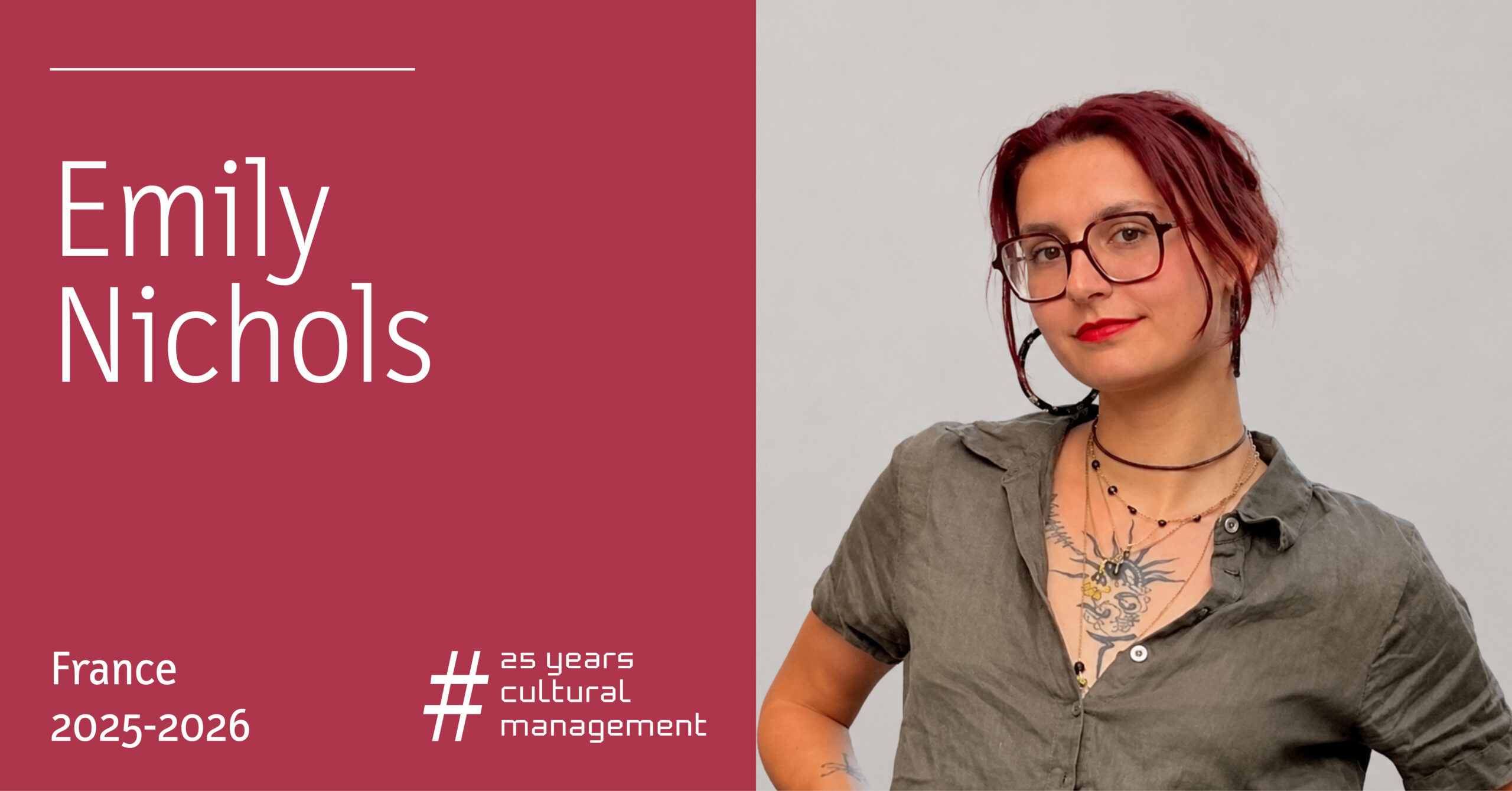
Emily Nichols is a Master’s student in Arts & Cultural Management at UIC Barcelona and founder of the Polysonic Festival in Paris, whose first edition launched in 2025. Alongside her studies, she has built hands-on experience in music programming, radio, venue operations, and festival production. In this conversation, she reflects on leaving Paris for Barcelona, entering the music industry through radio, and transforming a university project into a festival rooted in community, underground culture, and artistic transmission.
What motivated you to leave Paris and continue your studies in Barcelona? And why was Arts & Cultural Management the right next step for you at this stage of your career?
I decided to come to Barcelona because I wanted to leave Paris for a while and build a new network in another city. It could have been somewhere else, but Barcelona felt like the right balance. The studies here were closely connected to what I was already doing professionally, and the city itself is incredibly international and culturally alive.
I also wanted to broaden my understanding of cultural management. I already had experience in music and some background in the film industry, but I was curious to understand how other sectors work too, museums, performing arts, cultural institutions. Even if those worlds sometimes feel less familiar to me, I think having that wider perspective is extremely valuable.
Music has clearly been part of your life from an early age. Can you take us back to your first experiences with music and explain how those experiences gradually led you into the festival world?
Music has always been there for me. I started playing instruments very young and went to the conservatory, mainly studying piano and bass guitar. Later, in high school, I joined a programme that combined regular studies with music education, and that’s when I began thinking about music more seriously.
During summers, I worked in a record shop, and through that environment I slowly entered the live music scene. I met people organising concerts and festivals, and little by little I started attending gigs not just as a spectator, but understanding the work happening behind the scenes.
Then, during my bachelor’s degree, I completed a six-month internship at an independent radio station in Rouen. That experience really changed things for me because it introduced me to another side of music culture: programming, communication, and community-building.
For students who dream of working in music festivals today, where do you think is the best place to start?
Honestly, I think the most important thing is building connections. You can be extremely talented, but this industry is collaborative by nature, you never work alone. Networking matters because opportunities often come through people you meet along the way.
At the same time, I don’t think there’s one “correct” background for entering music festivals. Production, management, communication, administration, all of those skills are useful. You don’t necessarily need a music-specific profile. What matters is understanding what you’re good at and finding how your skills can fit inside the cultural sector.
You also worked in radio and electronic music broadcasting. What did those experiences teach you about connecting with audiences?
My first radio experience was at an alternative rock and pop-rock station. I used to write weekly chronicles and speak on air. It was actually there that I discovered I had what people call a “radio voice,” which was funny, and honestly, I still miss that atmosphere sometimes.
Radio taught me a lot about rhythm, storytelling, and atmosphere. Even without directly interacting with listeners, you learn how to guide people emotionally through sound and programming.
Today, my work in radio is more connected to electronic music and DJ culture. I coordinate DJ sets across different channels, which is another kind of curation. I definitely think these experiences influence how I approach Polysonic: not only booking artists, but creating a journey and an energy for the audience.
Polysonic began as a university project, but eventually became something much bigger. At what point did you realise the festival could exist beyond the classroom?
At the beginning, it honestly felt impossible. Polysonic started as my final bachelor’s project. I had no idea what to do, and the only thing I could imagine was creating a festival — even though it felt completely unrealistic. I had experience with concerts, but never with a full festival involving multiple artists, logistics, budgets, and partnerships.
Everyone advised me against it. Teachers in France told me it wouldn’t work. But eventually I realised I had no other idea I cared about as much, so I just decided to do it and learn along the way.
That process taught me something important: sometimes you only become capable of doing something by starting before you feel ready.
You mentioned that many people initially told you the project wouldn’t work. What kept you moving forward despite that skepticism?
I think it was partly stubbornness. But more than that, I really believed in the cultural and political importance of the project. Polysonic is deeply connected to underground sound system culture and to communities that are often underrepresented or misunderstood. For me, the festival isn’t just entertainment. It’s about visibility, transmission, and creating spaces where different musical cultures can coexist and connect. That motivation was stronger than the fear.
If someone had never heard of Polysonic before, how would you describe its identity?
Polysonic is about underground culture, freedom, community, unity, and transmission.
Musically, I love bringing together genres that don’t always share the same audience: cumbia, dub, techno, drum and bass, reggae. What interests me is creating encounters between people who might not usually be in the same space. I want people to leave the festival having discovered something new, not only musically, but socially and culturally too.
When curating the lineup, what matters most to you beyond musical genre?
For me, the most important thing is the people. As a young festival, it’s essential to know who I’m working with and what kind of environment we’re building together. I care deeply about promoting women in electronic music and making sure the festival feels safe and respectful for everyone involved. My non-negotiables are really about values and human dynamics more than genre itself.
You chose to structure Polysonic as an association rather than a company. Why was that important for you?
At first, the choice was practical. In France, opening and maintaining a company is expensive, while associations are more accessible and can apply for cultural grants.
But beyond that, I think the association model also reflects the spirit of the project. Polysonic has never been about making money for myself. I don’t live from the festival — all the money goes back into it. It’s something driven by passion, collective work, and community values.
What did the months leading up to the first edition actually look like behind the scenes?
Very intense. I’m the president of the association and the project coordinator, but Polysonic is absolutely a team effort. Most of my work focused on production, and two things became immediately clear: you need a venue and you need funding. Without those, nothing else can happen.
Once those foundations are secured, you can start booking artists, building partnerships, and shaping the programme, which is probably the part I enjoy the most.
Communication, however, was the hardest aspect for me. It requires constant consistency and visibility. We were posting several times per week, checking visuals, typography, flyers, social media strategy, every small detail mattered.
And as the festival approached, communication became physical too: handing out flyers outside concerts, speaking directly to people, creating visibility in real life.
As a founder, how do you balance creative ambition with financial reality?
You constantly adapt. As an association, so much depends on grants and funding applications. Sometimes you expect one amount and receive something completely different, so you have to rebuild the project around those realities.
For the first edition, the priority was simply making the festival happen. Now, for the second edition, the focus is more on collaborations and community growth. I try to invest where I think the project can become stronger and more sustainable long term.
When you imagine Polysonic in five years, what would success look like for you?
I’d love for the festival to become larger, possibly outdoors, and maybe even expand into a third day. But beyond size, success for me means building a real community around the project. In the long term, I would love Polysonic to become itinerant and travel to different cities or countries while keeping its identity intact. I love the idea of connecting people from different places through music.
How has studying Arts & Cultural Management influenced the way you approach Polysonic?
Even with experience, every country works differently. I already understood the French system, but studying in Barcelona is helping me understand how cultural structures function in Spain.
What I appreciate most is hearing directly from professionals and teachers who work in the field. Their experiences often help me navigate doubts or challenges I still face while organising the festival. Classes on funding, management tools, and performing arts have all been directly useful for the project.
Many students have creative ideas but feel paralysed by uncertainty. What would you say to someone waiting for the “right moment” to launch their first project?
Just do it. You will figure things out along the way. Feeling scared or uncertain is completely normal, especially when you’re doing something for the first time. You’ll make mistakes, everyone does. But making mistakes while doing something is still better than never starting at all.
Finally, if you had to recommend three festivals everyone should experience at least once, which would they be?
- Dekmantel Selectors in Croatia, because the atmosphere is incredible — beach settings, boat DJ sets, and some of the best electronic music programming in Europe.
- International Dub Gathering in Tarragona, which is one of the most important dub gatherings in Europe and brings together artists from all over the world.
And Rock en Seine in Paris, because it has evolved a lot over the years and continues expanding beyond rock into many different musical worlds.